
- Progress tracker
-
Freephone0800 731 4972
-
International+44 20 3455 0305
Sending Ashes Abroad with Fewer Delays and Surprises
Sending Ashes Abroad with
Fewer Delays and Surprises
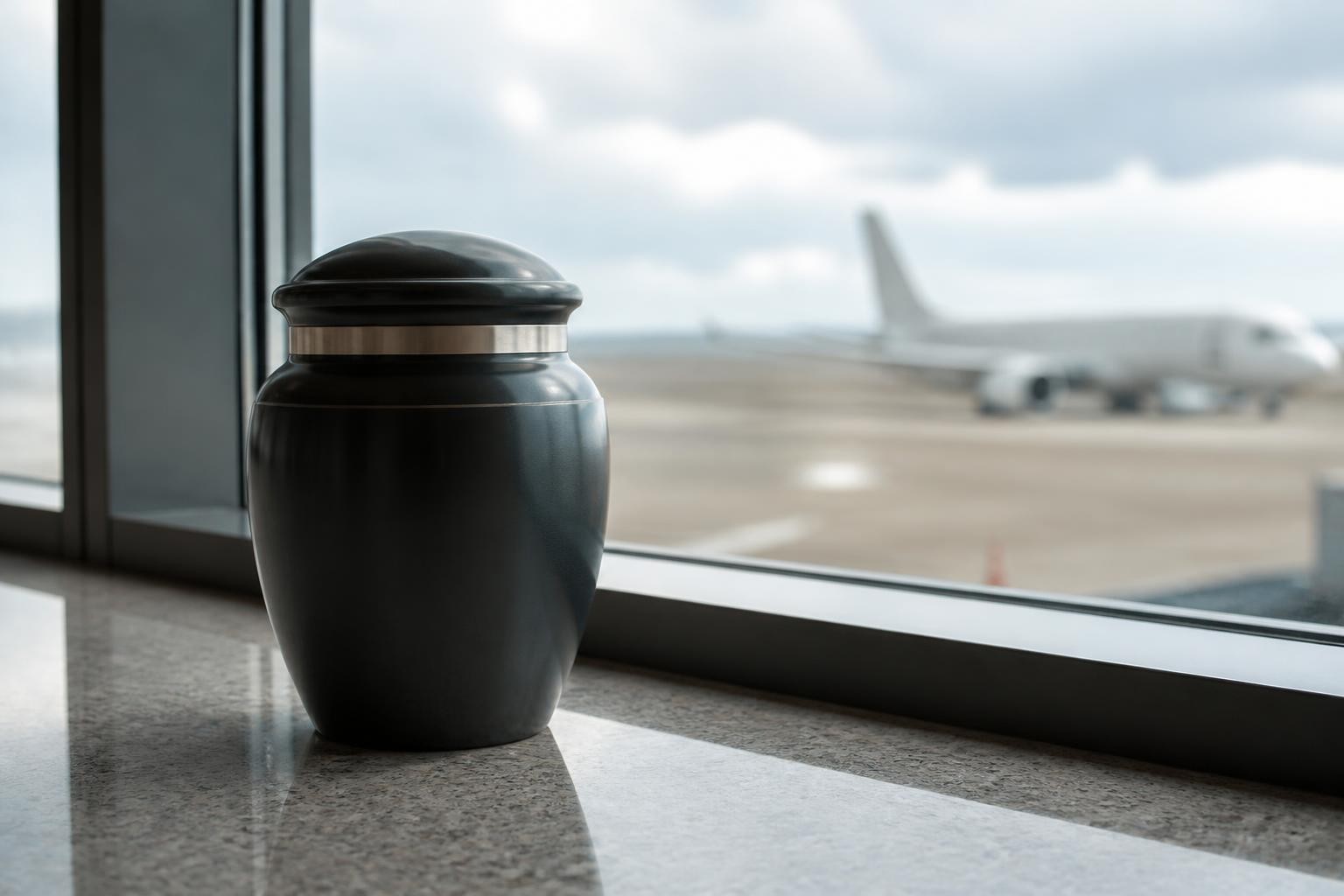
Sending ashes overseas is usually possible, but it is rarely as simple as booking a parcel or taking an urn to the airport. The quickest route on paper can become the slowest in practice if an airline refuses carriage at check-in, a courier will not accept Cremated Remains for that destination, or customs ask for documents that were not prepared in the right form. That is why families, funeral directors and corporate clients often ask us to set out the options clearly before any travel is booked.
At Mears Repatriation, we handle international movements every day through our International Repatriation Operations Centre. When ashes need to cross borders, the key is to match the route to the country, the paperwork and the timescale. A specialist repatriation service for ashes to another country is often the safest way to avoid delays, but it is not the only option. Below, we explain the main routes, the rules that affect them, and when professional support makes the greatest difference.
Which options are available for sending ashes to another country?
There are four main ways to move Cremated Remains internationally.
The first is to carry them personally. A family member or friend travels with the ashes in hand luggage, or in some cases checked baggage, depending on the airline's policy. This can feel the most personal option, especially where there is a memorial, burial or family gathering arranged soon after arrival. It can also work well on a direct route to a country with straightforward entry requirements. The difficulty is that the passenger takes responsibility for checking every rule in advance, including airline acceptance, security screening, transit requirements and the destination country's customs position.
The second is carriage with an airline as arranged transport. This usually applies where a funeral director or specialist coordinates the flight and supporting documents, even if the ashes are still collected by a family member at the far end. Some airlines are familiar with carrying Cremated Remains and have clear conditions on packaging, labelling and documentation. Others deal with such requests less often and may refer decisions to airport staff on the day, which creates uncertainty if the paperwork has not been checked properly in advance.
The third option is to use a courier. This can be suitable for some destinations, particularly where the receiving country accepts import by post or express shipment and the courier's own prohibited items list permits human ashes. The advantage is that the sender does not need to travel. The disadvantage is that many people assume all couriers will carry ashes internationally, when in fact acceptance can vary sharply by service level, route and destination. A courier may accept the booking initially, then place the shipment on hold once the contents and import rules are reviewed.
The fourth option is to use a specialist repatriation service. This is the route we arrange when families, funeral directors, governments or corporate clients want one point of contact to manage the process from collection to delivery. In practice, this means checking the destination's requirements, preparing the document pack, confirming the carrier's acceptance criteria, arranging compliant packaging and dealing with any embassy, consular or customs queries. Where a case involves onward transfer, multiple authorities or a sensitive timetable, a specialist service is usually the most controlled option.
For some clients, ashes are part of a wider repatriation case. We may first assist with cremation after an international death, then organise onward movement of the Cremated Remains. In other cases, ashes have already been released and the family simply needs help with export from the UK or import into another country. We handle both.
How do the rules differ between airlines, couriers and destination countries?
The main point to understand is that there is no single worldwide rulebook for ashes. Requirements can differ between the country of departure, any transit point, the airline or courier, and the country of arrival.
Airlines often focus on security screening and packaging. Many require the ashes to be in a non-metallic, securely closed container that can be screened by airport security equipment. If the container is too dense to scan clearly, it may be refused at security even if the airline itself would have accepted it. Some airlines allow Cremated Remains in cabin baggage only. Others permit them in hold baggage if packed correctly. Some insist on advance notification or documentary proof at the airport. These points are airline-specific, not general aviation rules.
Couriers apply a different set of controls. They consider whether the shipment is permitted under their own network rules, whether the destination allows import by courier, and whether customs clearance can be completed on the documents supplied. A courier may require the ashes to be placed inside an inner sealed container and an outer rigid shipping box, with full sender and consignee details and supporting certificates attached or uploaded. Even where a courier accepts the shipment, customs in the receiving country may still ask for clarification before release.
Destination countries vary the most. Some countries accept Cremated Remains with relatively simple documentation. Others require prior approval from a ministry, local health authority, embassy or consulate. In some places, the issue is not whether ashes may enter, but who may receive them and what declaration must be made. In others, customs want translated documents or a local funeral director to act as consignee.
Where a rule differs between the UK and the EU generally, it is important not to assume one covers the other. Within the EU, there is no single harmonised procedure that overrides each member state's own practice for importing Cremated Remains. A country inside the EU may still ask for documents or declarations that another EU state does not. Since the UK is outside the EU, movements from the UK into EU countries are international movements and should be treated as such, with customs and documentary checks considered case by case.
Transit points matter as well. A direct flight may be accepted, while the same ashes routed through another airport can be delayed because the transit country applies different handling or security standards. This catches families out when they book based on fare or convenience rather than route compliance.
That is why we verify requirements before movement starts. If ashes are travelling alongside a wider repatriation case, we also coordinate any linked arrangements, such as international repatriation documentation requirements, so the paperwork is consistent from start to finish.
What paperwork is usually needed?
The exact document set depends on the route and destination, but several documents are commonly requested.
The first is the death certificate, or an official certified copy. This confirms the identity of the deceased and is often needed by carriers, customs authorities and receiving funeral directors.
The second is the cremation certificate. In the UK, this is commonly the core document proving that the ashes are Cremated Remains released after a lawful cremation. Different crematoria issue slightly different paperwork formats, but the purpose is the same. If the ashes were cremated outside the UK, the equivalent local certificate may need translation or certification depending on the destination.
The third is identification information for the deceased and the sender or consignee. That may include passport details, proof of address, contact numbers and the name of the person receiving the ashes overseas. Some authorities want the relationship to the deceased confirmed as well.
The fourth is a declaration of contents or shipping statement. Couriers and customs authorities often want a clear description that the package contains human ashes, not a general term such as memorial goods or personal effects.
The fifth is any embassy or consular paperwork required by the receiving country. This can include legalisation, import permission, or confirmation from embassies, consulates or High Commissions. Requirements vary considerably. Some countries ask for original documents only. Others will accept scanned copies in advance but still require originals for release.
Depending on the route, additional documents may be needed, such as:
- airline approval or booking notes confirming acceptance of Cremated Remains
- a copy of the passport of the person carrying the ashes
- customs import forms
- translated certificates
- funeral director authorisation letters
- local receiving funeral home details
- proof of sealing or packaging compliance
If the ashes are part of a broader funeral or transport arrangement, supporting records may also sit alongside the file, even if not all are needed for customs. In body repatriation cases, for example, we may also deal with Embalming and Preparation, Casket / Coffins or Ritual Washing before a later cremation and onward movement of ashes. Those services follow different documentation paths, but the principle is the same, accuracy first. Clients who need a clearer picture of the document side can also review our guidance on documents used in international repatriation cases.
What are the practical risks of each option?
Each route carries its own risks, and most delays happen because one part of the chain has been assumed rather than confirmed.
With personal carriage, the biggest risk is refused travel on the day. A family may arrive with the ashes in an urn that cannot be screened, or with only a death certificate when the airline also expects the cremation certificate. If there is a transit airport, the passenger may discover too late that the onward carrier applies a stricter policy than the first one. The emotional strain can be significant because the person dealing with the problem is usually a close relative.
With airline carriage arranged informally, there is a risk of incomplete communication. One staff member may say ashes are allowed, but not specify that the container must be non-metallic or that advance approval is needed. Airport security staff and airline staff do not always apply the issue in exactly the same way, so a verbal assurance alone is not enough.
With courier transport, the most common risks are booking acceptance followed by compliance review, customs delay and poor destination handling. A parcel can be held pending extra documents, and that can be difficult to resolve quickly if no local consignee is in place. There is also the practical concern that some families are uncomfortable with ashes moving through a standard parcel network, even where lawful.
With any route, paperwork errors are a major source of delay. Names may be inconsistent across the death certificate, cremation certificate and passport copy. The consignee's address may be incomplete. A translated document may omit a key detail. Customs officers are unlikely to guess what was meant. They will usually hold the shipment until the discrepancy is corrected.
Timing is another risk. Families often book flights, memorial services or burial dates before the transport method has been properly cleared. If the ashes do not arrive on schedule, the practical and emotional consequences can be serious.
For funeral directors, employers, insurers and public bodies, there is also a reputational risk in managing an unfamiliar international movement without specialist support. A straightforward domestic release of ashes is one thing. Cross-border compliance is another.
When is a specialist repatriation service the better choice?
A specialist service is usually the better choice when there is any complexity beyond a simple direct journey with fully confirmed rules.
That includes urgent travel, where a family needs the ashes overseas for a service within days and cannot afford a failed airport attempt. It includes destinations with changing or less transparent import requirements, where local practice matters as much as published guidance. It also includes cases involving more than one authority, such as customs, an embassy, local health officials and a receiving funeral director.
Language barriers are another clear reason. A requirement may look simple when summarised in English, but the actual form, declaration or local instruction can be issued only in the destination language. We deal regularly with embassies, consulates and High Commissions, and we know when a document needs to be translated, certified or presented through a local contact rather than sent directly by the family.
A specialist repatriation service for ashes to another country is also valuable where the movement sits inside a larger case. For example, a death abroad may involve local release procedures, funeral arrangements in the country of death, cremation, and then transport of the ashes back to the UK or onward elsewhere. In those situations, one named repatriation specialist helps keep the process coherent.
This is also why other funeral directors, corporate clients and government bodies refer cases to us. Through Mears Repatriation, supported by our family background in Mears Family Funerals, we provide one case lead, one document trail and one practical plan. Steven Mears and his team have built our service around this specialist work, not as an occasional add-on.
In some cases, ashes are not the final decision and the family is still considering whether to repatriate the deceased before cremation or funeral. Where that applies, we can advise on the transport side as a whole, including destination handling and suitable funeral caskets and coffins for transportation if the case proceeds as a body repatriation rather than Cremated Remains. We can also help families understand destination-specific considerations by checking country by country repatriation destinations.
The better choice is not always the most complicated one. Sometimes the right answer is simply to confirm that a family can carry the ashes themselves with confidence. But where there is any doubt, it is better to resolve it before travel or shipment begins. That is how we reduce delays, avoid surprises and give bereaved families one less burden to carry.
Questions and answers
Can I take ashes on a plane from the UK?
Often yes, but airline and airport rules differ. You usually need supporting documents and a suitable container that can pass security screening. Always check both the airline and the destination country before travel.
Can ashes be posted to another country?
Sometimes, but postal and courier rules vary widely. Some destinations allow Cremated Remains only through approved services, while others restrict or refuse them altogether.
What documents are usually needed to send ashes abroad?
Commonly needed documents include the death certificate, cremation certificate and identification details for the sender and recipient. Some countries also ask for customs forms or embassy clearance.
Do I need permission from an embassy or consulate?
Not always, but some countries do require consular or embassy involvement. Requirements depend on the destination, and they can change without much notice.
Why use Mears Repatriation for ashes abroad?
Mears Repatriation can help when the process is unclear, time-sensitive or involves several authorities. Its specialist focus and experience with embassies, consulates and High Commissions can help avoid delays.